
Famine ራብ Fight Famine in all all of its forms !!!
Thursday, November 12, 2015


Ethiopia: Aid shortage threatens S.Sudan refugees - Sudan Tribune: Plural news and views on Sudan
Ethiopia’s refugee agency has launched an urgent appeal for food aid to assist hundreds of thousands of refugees particularly South Sudanese refugees.

- A South Sudanese refugee with her child on one of the buses that moved volunteers from the flood-prone Leitchuor and Nip Nip refugee camps in western Ethiopia (Photo courtesy of the UNHCR)
Administration for Refugee and Returnee Affairs (ARRA), a local implementing partner of UNHCR has called for supplies of food for over 730,000 refugees from South Sudan, Somalia, Eritrea and Sudan who are being sheltered at different camps in Ethiopia.
ARRA Director-General Ayalew Awoke Wednesday told reporters that the refugees mainly those from South Sudan, are in a critical state as the national refugee agency has run short of supplies of food for the refugees.
“The 730,000 refugees from South Sudan, Eritrea and Somalia will soon face chaos as the food aid in stock will be totally consumed by the end of December,” Awoke warned.
He had therefore issued a desperate call to international aid agencies to take swift action to deliver essential food aid.
Ethiopia has been working with various aid agencies to provide the necessary assistance to the refugees from neighbouring countries, he said.
“Some 90 per cent of the refugees sheltered in the camps are women and children,” Ayalew further said .
“Talks are under way with aid agencies,” he disclosed in statements to the official Ethiopian news agency.
However, according to Ayalew, even if the ARRA received a positive response from the agencies, it would take about two months for the food to finally reach to the needy which amplified the problem.
The appeal comes as Ethiopia battles to feed some 8.2 million of its nationals starving after El Nino weather phenomenon and drought, worst in over a decade hit the Horn of Africa’s nation and other countries in the region.
The United Nations is warning that Ethiopians who will need food aid by 2016 could nearly double unless help arrives in time.
Ethiopia’s government has mobilized $33 million in emergency aid.
The UN recently said it needs $230 million by the end of the year; however the Ethiopia’s government says it needs an additional $596 million in international assistance to avert a potential famine.
Ethiopia from 1983 to 1985 has experienced a significant famine which has cost the lives of more than 400,000 people and the government assures a magnitude of famine like then won’t happen.
Ethiopian officials say a long-running food security programme (Productive Safety Net Program) is protecting the poorest from starvation and the country hopes it will ultimately control the crises without any drought-imposed disaster.
Meanwhile the US Agency for International Development (USAID) on Tuesday announced it is providing nearly $97 million in additional food aid to assist populations in Ethiopia who currently are severely impacted by the El Nino weather phenomenon.
The American government humanitarian agency said the additional aid is to support the millions of Ethiopians in need of immediate food aid as well as to refugees from Somalia, South Sudan and Eritrea.
“USAID is contributing $58 million to its partner Catholic Relief Services for 105,700 tons of U.S. food; providing $19 million to the UN World Food Program (WFP) for its drought relief operation, and $20 million for its refugee assistance,” it said.
The United States has also pre-positioned relief commodities in Ethiopia to meet anticipated increased needs from El Nino.
“USAID food assistance contributions have been early and robust, thanks to the early warning and careful tracking of the progression of El Niño in the Horn of Africa” it said.
The projected level of need for emergency aid in Ethiopia has seen a sharp rise from 2.9 million people in early 2015 to 4.5 million people in August and to 8.2 million people as of mid-October.
USAID warns Ethiopia could likely face both prolonged drought and intense flooding that will further deteriorate food security as El Nino progresses into 2016.
Tuesday, November 10, 2015
Ethiopia appeals for help to feed thousands of refugees - US News
Associated Press

ADDIS ABABA, Ethiopia (AP) — An Ethiopian official says the country's more than 730,000 refugees could go hungry if $55 million in food aid is not raised by the end of the year.
Ayalew Awoke, deputy director of refugee affairs, said Monday that a $20 million donation by the U.S. will be used up by the end of December and he warned of "a major crisis" unless aid comes in.
Ethiopia, which currently hosts Africa's largest refugee population, is experiencing a major drought in its eastern and northeastern areas and has appealed for $596 million to feed its own population.
Dennis Weller, USAID director in Ethiopia, said in October that South Sudan's conflict is exacerbating Ethiopia's food insecurity. Hundreds of thousands of South Sudanese have fled to Ethiopia and live alongside local communities.
Copyright 2015 The Associated Press. All rights reserved. This material may not be published, broadcast, rewritten or redistributed.
Friday, November 6, 2015
Planning for El Niño Disaster foretold | The Economist
The world’s biggest climatic weather phenomenon is easier to predict than many calamities. But it shows the importance of preparing for other disasters, too

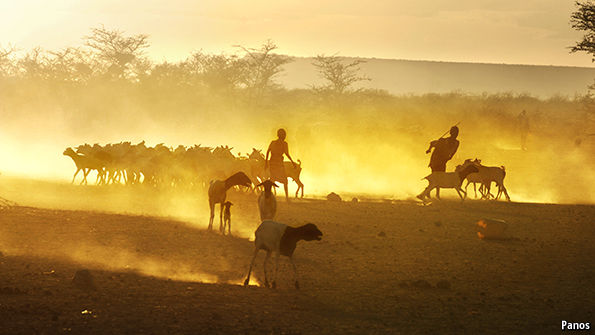
JUMPING a fence of prickly pears, Gumat Hussain, a local chief in the driest district of North Wollo, Ethiopia’s most drought-prone province, walks gloomily through his sorghum. “The crops have not produced grain. They are useless even for the animals,” he sighs. El Niño, the world’s largest climatic weather phenomenon, is keeping the rains away across swathes of Africa this year. Ethiopian officials say that the harvest is failing as completely as in a series of droughts that together killed more than 1m of the country’s people between 1965 and 1985, and made Ethiopia a byword for hopeless famine.
More than 8m Ethiopians are now going hungry. But a decade-old food-security programme is keeping the poorest from starvation—and showing how preparation for extreme weather events can mitigate the worst effects. In Africa’s largest social-protection scheme, 6m Ethiopians spend five days each month for the lean half of the year on public works such as digging water-holes for animals and building terraces for crops. In return they get 13kg of cereal and 4kg of pulses a month, or the cash equivalent. Another million who are unable to work get the handout, too.
El Niño was named after the Christ-child by Peruvian fishermen who noticed that the global weather pattern, which happens every two to seven years, cut their hauls around Christmas. El Niño sees warm water, collected over several years in the western tropical Pacific, slosh back eastwards when winds that normally blow westwards weaken, or sometimes reverse. America’s National Oceanic and Atmospheric Administration says this year’s Niño could be the strongest since records began in 1950.
Advertisement |
The weather effects, both good and bad, are felt in many places (see map). Rich countries gain more from mighty Niños, on balance, than they lose. Their largely temperate climes mean that extra deaths during heatwaves are more than offset by fewer during cold snaps. A study from the IMF and Cambridge University found that a strong Niño in 1997-98 boosted America’s economy by $15 billion, partly because of higher agricultural yields: farmers in the Midwest gained from extra rain. The total rise in agricultural incomes in rich countries is greater than the fall in poor ones, says Solomon Hsiang of the University of California, Berkeley. One knock-on effect of El Niño—fewer Atlantic hurricanes—particularly benefits America. (Storm activity in the Pacific, by contrast, increases.)

But in Indonesia tinder-dry forests are in flames (see next article). A multi-year drought in south-east Brazil is intensifying. Though parched California may gain relief if El Niño sweeps away a “blocking” ridge of high pressure that has diverted winter storms for the past four years, heavy rains on bone-dry land are likely to cause surface flooding and mudslides. In any case, what the Golden State most needs is snow in the Sierras to replenish its water supplies—unlikely in the heat of a Niño year.
The most recent mighty Niño, in 1997-98, killed around 21,000 people and caused damage to infrastructure worth $36 billion around the globe. But such Niños come with months of warning, and so much is known about how they play out that governments can prepare—if they are sufficiently farsighted. According to the Overseas Development Institute (ODI), a British think-tank, and the Global Facility for Disaster Reduction and Recovery, however, just 12% of disaster-relief funding in the past two decades has gone on reducing risks in advance, rather than recovery and reconstruction afterwards. That is despite evidence that a dollar spent on risk-reduction saves at least two on mopping up.
Simple improvements to infrastructure, such as those carried out by Ethiopia’s public-works programme, can reduce the spread of disease. Better sewers make it less likely that heavy rain is followed by an outbreak of diarrhoea. Stronger bridges mean villages are less likely to be left without food and medicine after floods. According to a paper in 2011 by Mr Hsiang and co-authors, civil conflict is correlated with El Niño’s malign effects—and the poorer the country, the stronger the link. Though the relationship may not be causal, helping divided communities to prepare for disasters would at least lessen the risk that those disasters are followed by bloodshed.
Stitches in time
Mexico has already reaped the benefits of astute planning. Hurricane Patricia, which hit its coast last month, was the strongest Pacific hurricane to reach land on record, probably because El Niño added to its oomph. It caused far less harm than expected. That was partly because it moved too fast to whip up a big storm surge at sea, and also because it passed only through rural areas of south-western Mexico. But it was also thanks to government readiness. More than 3,000 homes were damaged in the state of Jalisco, but no one was killed because residents had been moved to shelters built for just such an emergency. Almost a quarter of Mexico’s territory is vulnerable to tropical cyclones and the country suffers from around 500 floods a year. Consequently, at least 0.4% of the federal budget is used for disaster preparation—a decent chunk in a country where government spending is low.
Disaster insurance can be too costly for poor governments and individuals: uncertain demand, weak regulation and local corruption all put insurers off, too. But by making the cost of risks explicit, insurance can encourage their mitigation. Collective schemes, such as the Caribbean Catastrophe Risk Insurance Facility, can make insurance more affordable, and disseminate information that helps governments, citizens and those running ports and airports to prepare. Since the poorest are least likely to recoup their losses from disasters linked to El Niño, minimising their losses needs to be the priority.
Thursday, November 5, 2015
Faced with climate change, Ethiopia rediscovers an ancient staple crop | Global Ideas | DW.COM | 03.11.2015
Often dubbed the false banana, the giant enset is a staple crop in certain parts of Ethiopia. As climate change brings increasingly frequent droughts, the plant's versatility and resilience could help fight hunger.
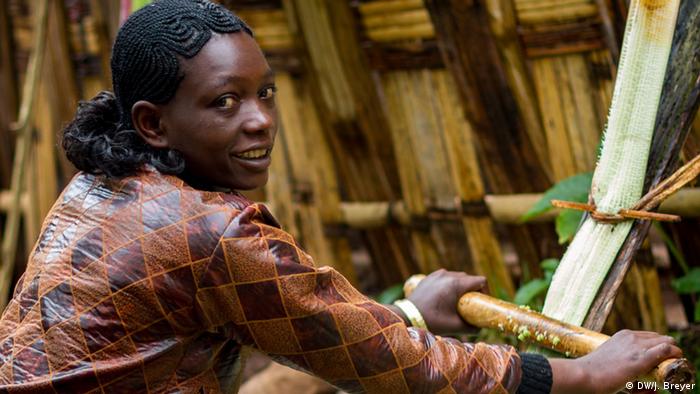
When 52-year-old Gebre Ynitso was a child in Ethiopia, he and his fellow villagers tended a towering plant with broad, lush green leaves. They harvested its roots and leaves for food and collected its fibers to weave into hats, sacks and even mattresses. No part of the plant went to waste.
"I would play hide-and-go seek in the dense enset plantation," said Ynitso, who also helped his parents transplant the enset, as the eye-catching crop is known. Ynitso also made toys out of its roots.
Endemic to Ethiopia, the plant has been cultivated there for more than 7,000 years. It's often dubbed the false banana because of its similarity to the banana tree. The enset can withstand droughts as well as heavy rains, making it ideal for cultivation in Ethiopia's climate.
Furthermore, climate change is causing increasingly harsher droughts in the southern highlands where the enset predominantly grows, which has led researchers to try and promote the old reliable crop to all Ethiopians as a resilient, famine food.
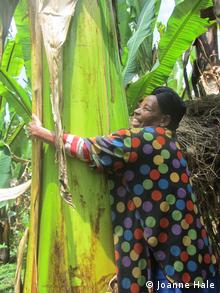
The enset takes four to five years to mature and can grow up to 6 meters tall
"One of the unique qualities of the enset is that it will always be around as a backup plan," said Ynitso, who now studies the plant as an associate professor at the Department of Social Anthropology at Addis Ababa University. "It's like money in the bank."
In most highland areas of southwest Ethiopia, where population density is high, the enset remains a popular crop and a staple food, said Ynitso. Yet in the midlands, where land scarcity is not an issue, attention has shifted to non-indigenous and soil depleting crops like maize for both commercial and domestic production. Younger people in particular often see it as old-fashioned.
A solid but underrated staple
Enset is a staple for 18 to 20 million people, or 20 percent of Ethiopia's population,says Joanna Hale, an international agricultural consultant formerly with aid organization USAID. It's often grown next to coffee, which thrives under the shade of its broad leaves. It seems like the swiss army knife of crops because of its many uses.
Apart from the fruit, which is inedible, much of the plant is eaten. Meat is often consumed with the corm, the robust root of the enset, which is boiled. Another popular dish, known as Kocho, is made from the powdered trunk and stalks and is fermented and eaten with a variety of breads.
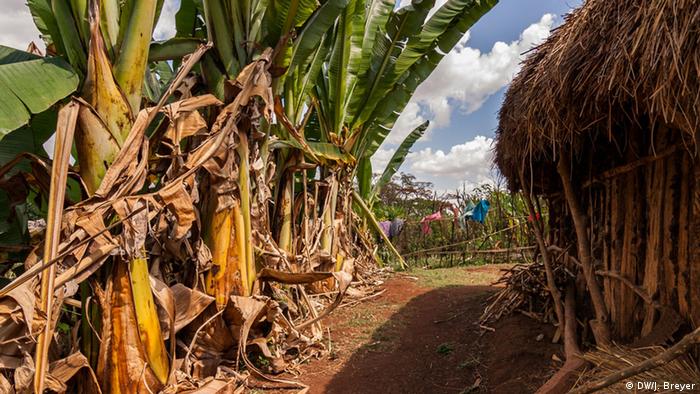
Enset is a back-up plan for many Ethiopians. When other crops wilter, the enset usually survives.
Bulla, a powdery by-product of squeezed kocho, is eaten as a porridge. Sometimes, Ethiopians also place chopped up corm in an earthen pit almost 2 meters deep and ferment it with yeast and starch. That way, it can last a number of years.
Cows and livestock also munch on the plant, providing protein in the form of meat for local families; the leaf litter that frequently falls from the huge plant improves soil fertility; and the enset has a small ecological footprint, producing 2.3 times more food per unit of land than cereal crops, says Hale.
"It's an underrated commodity, because it offers a lot for food security for low income groups," Hale told DW, pointing out that the enset region is one of the poorest and most densely populated in Ethiopia.
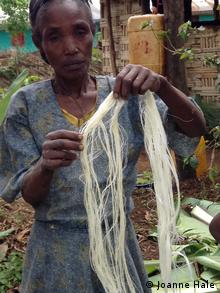
The fibres derived from the enset are commonly used to make sacks to carry coffee.
Population pressures are an issue across Ethiopia. The country's population has tripled to 94 million since 1933 and it is currently facing its worst drought in 30 years. Each year, 7.5 million people in the country go hungry and require food aid, according to the United Nations. As a result, opinions of the enset are changing once again.
"Enset has been under assault for many years now, but after the last food crisis [in 2011 and 2012] everybody's realizing they were wrong," Wolde Tadesse, a visiting researcher at the African Studies Department at Oxford University in the UK, told DW.
Those outside of the enset region viewed the plant as inferior to the crops they were used to and harder to cultivate than grain. But then "people who looked down at enset or never used it, started using enset to save their lives," he said.
Cultivating Greater Awareness of the Enset
Cultivating Greater Awareness of the Enset
In recent years, a slew of scientific, economic and cultural initiatives have cropped up aiming to cast the enset in a more modern light and emphasize its importance, says Tadesse, who grew up in the Gamo Highlands where enset is cultivated. He is now co-authoring a book on the crop. These initiatives hope to promote the enset in areas where it has fallen out of favor or never gained a foothold.
A new enset fiber factory is offering training in the best methods to dry enset fiber to ensure a high quality product. The fiber is now mostly used to make sacks to carry coffee. Arba Minch University in southern Ethiopia built an "Enset Park" to aid local farmers who are keen to stock up on seeds, or receive the materials needed to plant the crop.

The fibres can even be used to make paper.
In a bid to raise enset's popularity as a foodstuff, Dilla University in Gadeo will host "Enset on Wheels" food carts, while food festivals have also sprouted up. Local farmers showed the crop's versatility at a recent festival in Gadeo by presenting 32 different enset meals.
To tap back into the enset's roots as a culturally important crop, it's a matter of reminding people of its still enduring role in many traditions. Enset is used as a means of measuring social status, says Shigeta Masayoshi, a professor at the Center for African Area Studies at Kyoto University, who's been studying the crop for 30 years.
"How many crops of enset a man has shows how well he's respected in the community," he said. And the enset remains a ritual crop, still used in ways both Ynitso and Tadesse remember growing up. It is the food given to mothers after they give birth, and women pound on its stems at funeral ceremonies.
"What's important about the enset is that it keeps the family alive," said Tadesse. "It's the backbone of the family and community."
Tuesday, November 3, 2015
Ethiopia tries to avert another famine | The Economist
Mindful of past disasters, Ethiopians are readier than before to deal with drought

JUMPING a fence of prickly pears, Gumat Hussain, a local chief in the driest district of North Wollo, Ethiopia’s most drought-prone province, walks gloomily through his sorghum. “The crops have not produced grain. They are useless even for the animals,” he sighs. “My oxen and goats will soon die. Our people will wait only for the government to respond.”
In many lowland parts of North Wollo, a day’s drive north of Addis Ababa, the capital, the annual midsummer rains lasted for under a week. This was because of a particularly strong El Niño effect, which this year made swathes of Africa drier than usual, along with a longer-term drying of Ethiopia’s climate, especially in the north and east. Now it is harvest time and the tall, green crops belie their fruitlessness.
Ethiopian officials say that this failed harvest is as bad as the catastrophic droughts that befell Ethiopia in 1965-66, 1972-73 and 1984-85, killing more than 1m people in all. But a sophisticated food-security system means that poor Ethiopians these days can cope much better with drought than before.
“Many, many people died in the past. But we now have early-warning systems and programmes to mobilise grain from areas of surplus to areas of scarcity,” says Mohammed Yasin, head of Disaster Prevention and Food Security in North Wollo, a province whose name was once synonymous with famine. “We will avoid this problem without evacuating areas.”
The government says that 8.2m people (around 8% of Ethiopia’s population) have been affected by drought. Human factors can make things worse, as is happening across the border in South Sudan, where the UN says war and displacement means that at least 30,000 could starve (out of about 3.9m going hungry) because humanitarian agencies cannot reach them. But in Ethiopia the authorities are now arranging for a massive transfer of food aid from stores in the country and, eventually, from abroad. In the last big drought, in 2010-11, which hit the whole Horn of Africa, Ethiopians fared better than neighbouring Kenyans—and a lot more so than the people of Somalia, to the east.
Foreign aid has played a big part in alleviating Ethiopians’ plight, but the government has helped a great deal too. Extreme poverty in Ethiopia has been halved in the past 20 years. The economy has been one of the fastest-growing in the world and the government pays for an increasing proportion of the country’s social services.
The Overseas Development Institute, a British think-tank, puts much of Ethiopia’s ability to deal with drought down to its Productive Safety Net Programme (PSNP), Africa’s largest social-protection scheme. Set up in 2005, it puts around 6m able-bodied men and women to work for five days a month on public works, such as digging waterholes for animals or building terraces for crops. In exchange, their households and those of more than 1m less able citizens receive food or cash amounting to 13kg of cereal and 4kg of pulses a month for the leanest half of the year
Ethiopians are deemed to have “graduated” from the programme if they have weaned themselves off this welfare-for-work scheme, usually by diversifying from subsistence farming into more lucrative enterprises. One such graduate, Mulubrhan, lives in a highland village of North Wollo named Hanging Mule after an errant beast that hanged itself on its own bridle after falling from a narrow path. He owns around 100 eucalyptus trees which he gradually sells for firewood. He also has half a stake in a small flour mill, which grinds teff, Ethiopia’s staple seed, used for baking the traditional bread known as injera. “Before, my focus was only on feeding my six children,” he says. “The PSNP helped me to focus on making money.”
Poor Ethiopians have gained much from the PSNP and from the government’s agricultural policy. But the population, at 95m-plus the second largest in Africa, is growing so fast amid a drier climate that the state’s food-security programme is still under severe pressure. Ethiopia’s dependence on food aid varies as much as its erratic climate. The PSNP is designed to preserve people against “moderate shock”, but in years such as this one, that resistance is eclipsed by the magnitude of the drought, so needs to be supplemented by foreign help. The British government, which gives more development aid to Ethiopia than to anywhere else, has just promised an extra £45m to feed 2.6m people. Ethiopians hope that other foreign donors will chip in soon.
Subscribe to:
Posts (Atom)